Review of Existing Works
Proto-Solarpunk |
|||
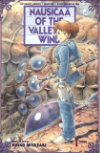 Nausicaä of the Valley of the Wind (1982/4) |
Nausicaä of the Valley of the WindManga and Subsequent Ghibli film by Hayao Miyazaki. Environmentalism is a major theme in Miyazaki's work. This film has some groundbreaking themes that have inspired subsequent generations. In a world whose landscape became toxic after a cataclysmic war 1000 years ago, the princess Nausicaä fights to protect her homeland which is surrounded by a toxic forest. The giant bugs inside the forest - the Ohm - are feared, but Nausicaä discovers that they are actually purifying the toxic lands and earns their trust. |
||
| Jam's cold take: | Many of Miyazaki's films demonstrate his profound respect for the natural world. Something that has always struck me about his work is how the humans are not there to "save" anything - the world has everything it needs to heal itself, we just have to stop destroying it. | ||
| Is it Solarpunk? | Miyazaki's works have always felt more "mystical" and fantastic to me, and the world of Nausicaä diverges from our own in many ways. I think that the themes of his work have informed what Solarpunk is becoming as a genre. | ||
|
|||
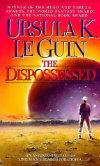 The Dispossessed (1974) |
The DispossessedNovel by Ursula K. LeGuin Some lists of Solarpunk works include the Dispossessed. It is one of the first works to describe an "anarchist utopia". The main character Shevek comes from a moon called Annares, where people are free and independent, but developed a collectivist mindset to survive the harsh landscape. He spends most of his time in the novel on the plant Urras, in a region that is capitalist and patriarchal. The book contains many of his observations on the differences between these societies. |
||
| Jam's cold take: | LeGuin's novel does an excellent job of fleshing out the concept of an anarchist society, and then writing from "inside" that perspective. It's also interesting because even though it is described as a "utopia", life on Annares is never portrayed as being easy. It's a wonderful example of showing how different life could be only for changing ourselves. | ||
| Is it Solarpunk? | The book describes an "ecological and social collapse" that took place on Earth, but it doesn't focus on those events or the specific ramifications of them. While it does describe the society as living within the limits of a harsh environment, it is not focused on environmentalism. For these reasons I don't think it's quite solarpunk, but is definitely a foundational work for those considering alternate societal structures. | ||
Contemporary |
|||
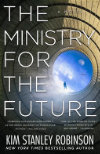 The Ministry for the Future (2020) |
The Ministry for the FutureNovel by Kim Stanley Robinson This novel imagines a ministry created by the UN to enforce the Paris agreements. It follows the career of this ministry's leader as policies are implemented. Throughout the years the effects of these policies are examined through various global perspectives. It also vividly describes various eclological catastrophes that are the result of the changing climate. |
||
| Jam's cold take: | I'm glad this book exists, because I think it occupies a space that had to be explored in the development of solarpunk as a genre. Cynically, I like to think of this novel as "Business as Usual: The Musical". It's very optimistic in a way that I don't fault it for, but also that I don't laud it for. It's about as "punk" as a UN meeting. The description of ecological disasters and interventions, however, are excellent and worth the price of admission on its own. Update: I enjoyed this thorough review and examination by axld | ||
| Is it Solarpunk? | I say yes, but it's a lot more "solar" than "punk". Despite some efforts to globalize the narrative, I found it very Western-centric in its perspective. | ||
|
|||
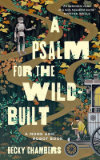 A Psalm for the Wild Built (2021) |
A Psalm for the Wild Built(and Monk&Robot series sequels) Novels by Becky Chambers In a post-transition world where humanity lives in harmony with its environment, a non-binary monk travels around the country in an e-bike powered tiny house to emotionally support citizens with tea ceremonies. Driven by a mysterious sense of dissatisfaction, they go off the beaten path to discover a sentient robot. It is the first to reach back out to humanity since they all left hundreds of years ago. |
||
| Jam's cold take: | This book may as well have been written for me, personally. I have read the first two and anxiously await the third. I loved the way the society was portrayed, I loved the concept of a tea ceremony, I loved the concept of the robots gaining sentience and going to be in tune with nature. I am so glad that I can hand people this book to try and describe solarpunk rather than pointing to a yogurt commercial. | ||
| Is it Solarpunk? | Unequivocally yes. I only wish that it was better tied to present day and was about "us" solving "our" problems, but I don't think that is strictly necessary for the genre. | ||
|
|||
 Walkaway (2017) Walkaway (2017) |
WalkawayNovel by Cory Doctorow In the near-future, capitalism tightens its grip on the populace even farther. The world is ruled by billionaires, but some have found the means to escape by simply "walking away." They have forged their own fledgling society based on a post-scarcity, post-work ethos. |
||
| Jam's cold take: | I really like Cory Doctorow's works. Big fan. It is with the deepest respect that I offer that this book is "Burning Man Made Manifest" (the concepts of the gift economy especially), and also that there's a reason that Black Rock City only exists for a week at a time. I really enjoyed the Late-Stage cyberpunk beginnings of this novel, and I would describe this as "Transition" Solarpunk. It explores some really interesting ideas including how society would be altered if we could reproduce human consciousness in a digital world. | ||
| Is it Solarpunk? | I say yes, but it's a lot more "punk" than "solar". It's a good counterbalance to The Ministry for the Future. The genre I'm aiming for is somewhere between those two books I think. This book doesn't explore much in the way of environmental degradation or solutions. I don't think the matter synthesizers are quite in tune with the solarpunk ethos, but I also don't think it's quite what Mr. Doctorow was going for anyway. I thought it was a good novel regardless. | ||
|
|||
Life Finds a Way (2020)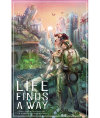 |
Life Finds a WayComic Anthology edited by Alina Pete and Dan Anctil, published by Cloudscape Comics This comic anthology presents a range of stories, all of which explore a "post-apocalypse" where people found a way to survive and thrive. It was explicitly focused on presenting "positive" post-apocalyptic stories. |
||
| Jam's cold take: | Full disclosure: the editors of this work are close personal friends. As such, I know that while it narrowly pre-dates Solarpunk as a term, it is absolutely in line with the ethos of what that genre is aiming to be. The comics are necessarily short and so only offer glimpses into the different worlds, but the wide range of perspectives make up for this limitation. | ||
| Is it Solarpunk? | Unequivocally yes. Some stories align more closely to the aesthetic than others, but all of them emphasize optimism about the future which is cornerstone to the genre. | ||
|
|||
Strange World (2022)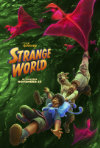 |
Strange WorldAnimated film by Disney Disney didn't market this film as Solarpunk (and they marketed it fairly little overall), so I was surprised by some strong solarpunk themes in this work. For a detailed analysis that I agree a lot with, I recommend this video:"Disney's Strange Solarpunk World" by Pop Culture Detective. |
||
| Jam's cold take: | Someone had an agenda here and I'm pretty impressed at what they managed to get through the Big Mouse machinery here if I'm being dangerously honest. Narratively it's not my favourite film, but if you're interested in the genre it's worth a watch to see how they handle the themes. Also there's fantasy-Catan and Caravan Palace in the soundtrack which is enough for me to enjoy it. | ||
| Is it Solarpunk? | Stealth yes. You only have to scratch it with a fingernail to see it. The farm-community aesthetic + plant-based airship tech is solarpunky on an aesthetic level on its own, but then the plot makes it unequivolcal. Spoilers: A community is made propserous by a miraculous energy source. It was discovered that the energy source was actually killing their world (LITERALLY A TURTLE ISLAND), and they were forced to give up their easy energy for the sake of saving the environment. They do this and find a way forward with wind power after a period of hardship that they endured peacefully as a community. I mean. It doesn't get much more solarpunk than that. | ||
To-Read Pile:
- Ecotopia
- Parable of the Sower (Earthseed Series) - (I've read about half)
- Afrofuturism and Afrosurrealism (Black Panther, Iwájú(possibly? to be released))
- Cyberpunk - Diamond Age perhaps (post-cyberpunk)
- New Weird - Annihilation
- Gentle Games (Pokemon, Stardew Valley)
- Cradle to Cradle
- Silent Spring
- Sustainability by Design
Post-Apocalyptic Works of Note
Adjacent Genres
Nonfiction Works of Note